How much does a digital twin cost? Build, run and payback, line by line

A digital twin of one office building costs roughly $32,000 to $200,000 to build and about $750 to $1,100 a month to run, on today’s published price lists. The biggest one-off cost is the 3D model: if you already have the BIM, you skip most of it.
That range is for a sample 40,000 sq ft office with sensors in 40 rooms, 24 energy meters, a maintenance app and fault-finding software. Every number below links to the vendor or government page it came from. None of them are my prices.
The interest is real. In an August 2024 explainer, McKinsey reported that 70 percent of C-suite technology executives at large enterprises are already exploring and investing in digital twins, and projected the market to reach $73.5 billion by 2027.
What are the levels of a digital twin?
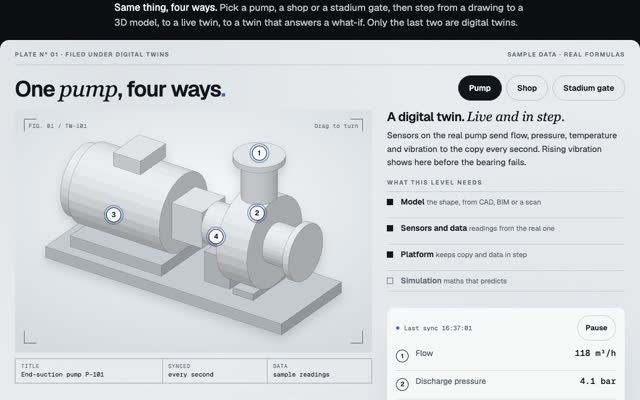
The Digital Twin Consortium defines a twin as a virtual representation of real things and processes, synchronised at a specified frequency and fidelity. In practice a building twin comes in three levels, and each one costs more than the last.
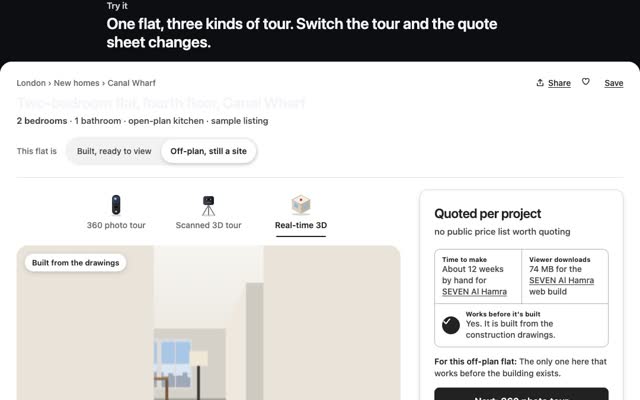
- Visual model. A real-time 3D copy you can walk through, built from the construction files. I turned SEVEN’s Revit, IFC and Navisworks models for Al Hamra in Riyadh into a building you can walk in a browser, before it was built. At Expo 2020 Dubai my team of 12 worked on Virtual Expo Dubai, the whole site in real-time 3D. The Expo closed. The twin is still live.
- Live data twin. The same model with real readings on it: who is in which room, what each circuit draws, which work orders are open. This is the “synchronised” half of the definition.
- Simulation twin. The live twin plus a model that predicts: what happens to energy use if you change a setpoint, and which equipment is quietly wasting power.
For the FIFA World Cup in Qatar, Expo 2020 and SEVEN, I turned engineering models into live Unreal and Unity environments. That is the first level. The other two levels are where sensors, platforms and monthly fees come in.
How much does it cost to build a digital twin?
These are the lines for the sample office, from published prices checked in October 2026, in US dollars.
- Laser scan of the building: $0.20 to $0.70 per sq ft, so $8,000 to $28,000 (The Future 3D, March 2026).
- BIM model from the scan, at LOD 300: $1.50 to $3.50 per sq ft, so $60,000 to $140,000. Skip both lines if you already have the BIM, as SEVEN did. You still pay for the clean-up that makes it run in real time.
- Occupancy sensors: $229 per sensor plus $8 per room a month on Density’s published price list: $9,160 for 40 rooms, then $320 a month.
- Energy submeters: in a GSA field test (January 2021), each measured load cost $900 installed, $470 for equipment and $431 for the electrician, with analytics at $12 to $48 per meter a year. For 24 loads: $21,600.
- Maintenance tickets: MaintainX Premium is $65 per user a month, billed annually, and it is the plan with API access, which you need to put tickets on the model. Five technicians: $325 a month.
- Fault-finding and analytics software: across Lawrence Berkeley National Laboratory’s campaign, the median cost was $0.03 per sq ft to install and $0.02 per sq ft a year (2019). For this office: $1,200, then about $67 a month.
- Energy simulation engine: EnergyPlus is the US Department of Energy’s open-source engine, so the software is free. Building and calibrating the model is engineering time, quoted per project.
Switch layers on below and watch the plan, the ledger and the timeline change. The figures are the ones above.
Light up a building. Switch on the layers of a twin, one by one, and the ledger prices each from its published source.
3D model from
Twin platform
- To build, one-off
- $68,000 to $168,000
- Each month
- $267
- Model ready
- 3 weeks +
One-off
Each month
Sample 40,000 sq ft office: 40 rooms with sensors, 24 metered loads, 5 technicians. Room counts, readings and tickets on the plan are sample data. Prices are published US list prices checked in October 2026, in USD, with the source on every line.
How much does a digital twin platform cost?
The platform holds the model and the live data and is the smallest line on the bill.
- Autodesk Tandem: from $267 a month, with a free tier to try it. Built around BIM, so it suits facilities that already have Revit models.
- AWS IoT TwinMaker: $1.50 per million data calls, $0.05 per entity a month and $0.50 per 10,000 queries. AWS’s own 800-entity example comes to $197.53 a month, or $220 on the fixed bundle.
- Azure Digital Twins: pay per use. In East US, $2.50 per million operations, $1.00 per million messages and $0.50 per million query units. 64 devices sending one reading a minute is about 2.8 million operations and as many messages a month, roughly $10.
Which digital twin software is best?
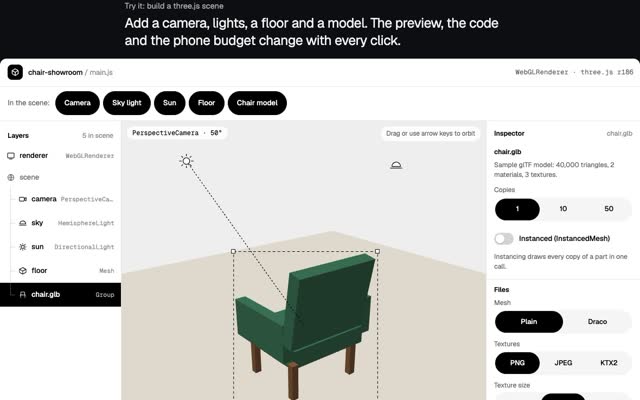
It depends on who runs it. Tandem if your facilities team has the BIM and wants a product on day one. Azure Digital Twins if you have developers and want your own app on a graph you control. TwinMaker if your data already lives on AWS. For the 3D people actually walk through, on a phone or in a browser, I use Unity and Unreal; how I get a 650 MB model down to a 74 MB build is in Unity WebGL on mobile.
How long does a digital twin take?
- 3D model from existing BIM: SEVEN Al Hamra took just under 12 weeks from first access to sign-off, by hand.
- Laser scan: 1 to 21 days of turnaround, before the modelling starts.
- Energy meters: at the GSA test, an electrician installed 6 meters in 6 hours. In a GSA full-panel test (May 2019), 5 panels with 96 breakers took 14 hours, and connecting the data to GSA’s analytics platform took 12 hours.
Sensors, tickets and simulation have no public install times. They run alongside the model, so the model sets the date.
Where do digital twin cost savings come from?
The savings come from the data layers. These are the published results.
- Fault detection: in LBNL’s campaign of 96 organisations and nearly 6,000 buildings, fault detection tools gave a median 9% energy saving, $0.24 per sq ft a year, with a one to two year simple payback (US DOE, November 2019). For 40,000 sq ft that is about $9,600 a year.
- Energy information: the same campaign found a median 4% saving, $0.04 per sq ft, from energy information systems alone.
- Submeters: at a courthouse in Salt Lake City, circuit-level submeters paid back in 0.6 years, from fairer tenant billing and a 10% average cut in HVAC load in the GSA test.
- Maintenance: the DOE’s O&M Best Practices Guide estimates preventive maintenance saves 12% to 18% over fixing things when they break, and predictive maintenance 8% to 12% more.
The visual model pays back differently. Before opening, a model like SEVEN Al Hamra’s does leasing, pre-opening marketing and design reviews.
How do you start a digital twin small?
- Pick one number. Energy cost per sq ft, open work orders, or rooms booked but empty. Every layer has to move it.
- Use the files you have. BIM, CAD, floor plans. On SEVEN Al Hamra the construction models were the start: the building was not built yet, so there was nothing to scan.
- Start on one floor. Meter the big loads and put sensors in the meeting rooms. That is under $8,000 on the lists above.
- Rent the platform month to month. The platform is the cheapest line. Change it later if you outgrow it.
- Add fault detection before simulation. Its published payback is one to two years.
- Scale floor by floor once the number moves.
If you want the 3D side, I compare engines, devices and costs for stores, shows and venues in virtual stores, live shows and 3D worlds.
Questions people ask
What is a digital twin?
A live, virtual copy of a real building, machine or process, kept in step with the real thing by sensor data, so you can see, test and plan on the copy first. The Digital Twin Consortium defines it as a virtual representation synchronised at a specified frequency and fidelity.
How much does a digital twin cost?
For a 40,000 sq ft office, about $32,000 for sensors, meters and software if you already have the BIM, and about $100,000 to $200,000 if you have to scan and model it first. Running it costs about $750 to $1,100 a month with every layer on.
What is the cheapest digital twin platform?
On usage, Azure Digital Twins: a small building can run for tens of dollars a month. Autodesk Tandem starts at $267 a month and AWS IoT TwinMaker’s bundle at $220 in AWS’s own example.
Do I need a 3D model for a digital twin?
For the live data, no: a floor plan can show it. For people to walk the building before it opens, or to see where a fault sits behind a ceiling, yes.
What are the cost savings of a digital twin for buildings?
Published medians are 9% of energy cost from fault detection and 4% from energy information systems, with one to two year paybacks. Preventive maintenance saves 12% to 18% over fixing things when they break.
How long does it take to build a digital twin?
The model sets the pace. SEVEN Al Hamra took just under 12 weeks from construction models to a signed-off build. Meters go in within days.
If you have the BIM and want a twin people can walk through, see how I take on 3D web projects or write to m@tawfik.tv.