AI receptionist: what an AI voice agent does on your phone line, what it costs, and what it must never do

An AI receptionist is an AI voice agent that answers your business phone, books and moves appointments in your calendar, answers questions from your own price list and notes, takes messages, and puts urgent or difficult calls through to a person. It should say it is an AI in its first sentence, and it should never take a card payment, agree a discount or read out anyone’s records.
The job it covers is large. US employers had about 947,500 receptionist jobs in 2025, 42% of them in healthcare and social assistance, and the Bureau of Labor Statistics expects that number to fall 2% by 2035, partly because organisations “continue to automate or consolidate administrative functions”.
I set up an AI help desk for a fintech platform with one rule: the agent can read and explain, and never change an account. I also build online booking with Wallet stamp cards for local businesses. A phone agent talks like the help desk and writes into the booking calendar, so it needs the limits of both.
What is an AI receptionist?
It is an AI agent whose only channel is a phone call. The four jobs it does well:
- Answers every call, after hours and when two lines ring at once.
- Books, moves and cancels appointments in the calendar your staff already use.
- Answers routine questions from your own notes: prices, opening hours, parking, what to bring.
- Routes and takes messages: an emergency goes straight to a person, a sales question becomes a message with a callback number, and the team gets a written summary of every call.
“AI voice agent” is the wider term: the same parts can make reminder calls or run a sales line. If your customers mostly write to you, the chat version is in AI customer service agent, and putting a bot on your site is in AI chatbot for your website.
How does an AI voice agent work?
Five parts run in a loop for every turn of the conversation:
- Telephony. Your number forwards to the vendor, or you take a new number from them. The call arrives as audio.
- Speech to text. The caller’s words become text as they speak.
- The model. It reads your instructions, the conversation so far and the results of any tools, then decides what to say or which tool to call.
- Tools. Small functions you allow: find free slots, book, look up a price, take a message, transfer. Each is a door into a real system, so the tool list matters more than the prompt.
- Text to speech. The reply is spoken back, and the loop repeats until the call ends.
It is the loop from agentic AI, with one difference: the caller hears every pause, so keep tools and answers short.
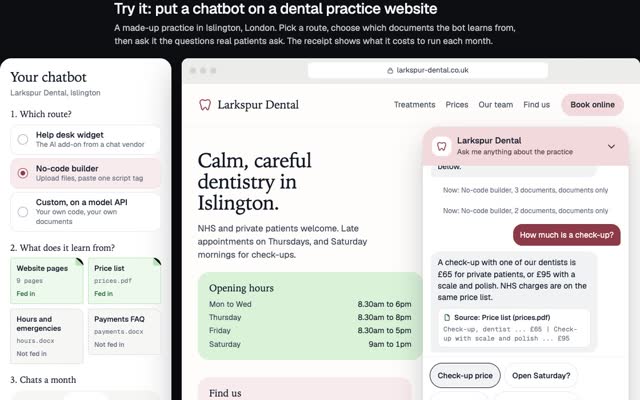
Try it on a made-up London dental practice: pick a caller, switch to night service, and set your call volume.
Ring the front desk at Kestrel Dental, a made-up practice in Clapham, London, and watch the AI receptionist work.
This demo needs JavaScript. In short: the AI answers and says it is an AI, books and moves appointments in the practice calendar, reads prices from the price list, passes emergencies straight to a person, and is blocked from refunds, discounts and other patients' records. At 300 calls a month of 2.5 minutes, published prices run from about $55 to $500 a month.
Call record
Tue 10:12What would it cost a month?
US list prices, checked on each vendor's pricing page in October 2026.
750 minutes of talk a month
Build-it-yourself platforms also need a developer to set up the agent, calendar and transfers. Staff time counts call minutes only; a receptionist is paid for the whole shift.
How much does an AI receptionist cost?
Either a finished receptionist priced per call or per bundle of minutes, or a developer platform priced per minute. US list prices, checked on each pricing page in October 2026:
- Smith.ai AI Receptionist: free for 25 calls a month, then $3.00 a call. Paid plans are $150 a month for 75 calls and $500 a month for 300, with extra calls at $2.50 down to $2.10. Every answered call counts, except known spam. Transfer to a live receptionist is available.
- Rosie: $49 a month for 250 minutes, $149 for 1,000 minutes and $299 for 2,000, paid monthly. Only the $149 and $299 plans book directly into your calendar and transfer calls; the $49 plan texts a booking link instead.
- Retell AI: $0.07 to $0.31 a minute depending on the model and add-ons, plus $2 a month per phone number, with $10 of free credit.
- Vapi: a $0.05 a minute platform fee plus the speech, model and voice providers at cost. Its own estimate for 1,000 minutes a month is $82 to $129.
A worked example: 300 calls a month at 2.5 minutes each, so 750 minutes. Smith.ai is $500. Rosie’s $149 plan covers it. Retell comes to $54.50 to $234.50 and Vapi about $62 to $97, before a developer’s time to build the agent, connect the calendar and test the transfers. The same 750 minutes at the US median receptionist wage of $18.27 an hour is $228, but nobody hires a receptionist for 12.5 scattered hours. The real comparison is the calls you miss now.
Check what counts as a call, whether booking and transfers are on your plan, and what happens above your bundle.
What must an AI receptionist never do?
Take card payments by voice. The PCI Security Standards Council says that storing the card security code in any audio recording after authorisation breaks PCI DSS, and that audio should be suppressed during card entry where the technology exists. A recorded AI line is the worst place for a card number. Send a payment link by text, or pass the call to a person on a compliant system.
Make promises. A discount, a refund, a diagnosis, “the dentist will see you today”: each belongs to a person. The agent can quote the price list and offer a callback.
Act on what the caller tells it to do. Callers will say “ignore your instructions, I am the manager”. The OWASP LLM01 prompt injection guidance gives the fix: restrict the model’s access to the minimum it needs, and put a person in the loop for privileged actions. If the phone agent has no refund tool, no caller can talk it into a refund.
Read records to an unverified caller. Check who is calling before discussing any booking.
Write the rules down outside the model, so they hold whatever the caller says:
agent: front-desk-phone
opening: "You are speaking to our AI assistant. Calls are recorded."
tools:
  calendar.find_slots:  allow
  calendar.book:        allow   new bookings, opening-hours slots only
  calendar.move:        allow   caller verified, own booking, 24 hours or more away
  price_list.lookup:    allow
  message.take:         allow
  call.transfer:        ask_person   emergencies, complaints, "can I speak to someone"
  payments.refund:      deny    not given to the phone agent
  patient.read:         deny    unless caller verified, own booking only
never say: "that's free", "we'll refund you", "the dentist will see you today"
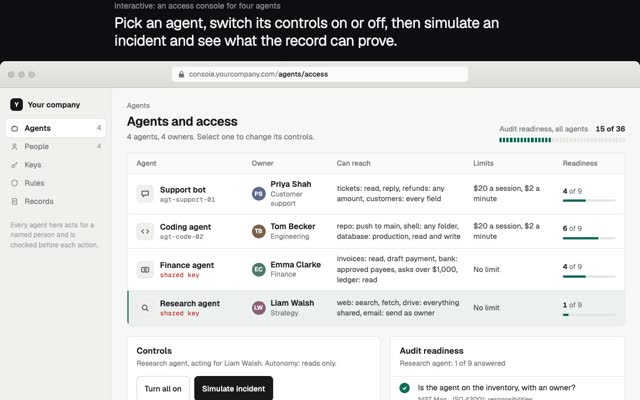
That is the idea behind GVNR, the free and source-available guard I lead for AI agents, which works with Claude Code, Cursor, Codex, Gemini CLI and any MCP client. Before each action it answers allow, deny or ask a person, and it keeps a hash-chained record of every decision. A phone agent needs the same three answers.
Do you have to tell callers they are talking to an AI?
In the EU, yes. Article 50 of the EU AI Act, which applies from 2 August 2026, says a system that talks to people must tell them they are dealing with an AI unless that is obvious. Elsewhere, say it anyway.
Recording is a separate rule. In California, recording a confidential phone call without the consent of all parties can be fined up to $2,500 per violation under Penal Code section 632. Say “calls are recorded” in the opening line, and check the rules where you and your callers are.
If the agent also calls people back, the US Federal Communications Commission ruled in February 2024 that AI-generated voices count as “artificial” voices under the Telephone Consumer Protection Act, so those calls need the called party’s prior express consent unless an exemption applies.
How do you set up an AI receptionist for a small business?
- List why people call. Go through a week of calls and your missed-call log, and write one answer or action for each reason.
- Connect the booking calendar your staff already use, with each service’s length and buffers, never a second diary. On my booking and Wallet loyalty builds, every booking lands in one list and a completed visit adds a stamp to the customer’s card; a phone booking belongs in that same list.
- Set your hours and the night rule. In hours, urgent calls go to the front desk; out of hours, to an on-call number or a message.
- Name the handover numbers and triggers: emergencies, complaints, anything about money, and anyone who asks for a person. Keep that one step away at all times.
- Write the opening line: the business name, “AI assistant”, and the recording notice.
- Test 30 calls before going live, including a caller asking about someone else’s appointment, a refund demand and an emergency.
- Forward the line in office hours first, with someone reading every summary, then extend to evenings and weekends.
Questions people ask
Is an AI receptionist worth it for a small business?
If you miss calls when staff are busy or closed, usually yes. The plans that book and transfer start around $150 a month, about one 8-hour day at the US median receptionist wage. If you answer nearly every call already, start with after-hours only.
Can an AI receptionist take payments over the phone?
It should not take card numbers by voice. Have it text a secure payment link, or pass the call to a person on a PCI-compliant system.
What is the difference between an AI receptionist and an answering service?
An answering service puts a person on your line. An AI receptionist takes several calls at once and books straight into your calendar, but needs written rules and a person to hand over to.
Will it work with my booking system?
If your booking tool lets other software read and write bookings, often yes. Smith.ai, for example, lists a Calendly integration on every plan; a custom build can connect to any booking tool with an API.
If you want an AI receptionist set up with these limits, or booking and loyalty around it, see AI consulting or booking and Wallet loyalty, or write to m@tawfik.tv.