What is a stablecoin? How the peg holds, the types, and why some broke

A stablecoin is a token on a blockchain built to stay worth a fixed amount of normal money, almost always one US dollar. The issuer holds a reserve of cash and short-dated government debt behind every coin, and buys coins back for dollars at that fixed price.
Two issuers hold most of the market. Tether reported about $184.6 billion of USDT in circulation on 30 June 2026, over 60% of all stablecoins, in its Q2 2026 attestation prepared by the accounting firm BDO. Circle reported $73.3 billion of USDC at the end of the same quarter in its second quarter results.
I’m Mo Tawfik Khalifa, chief product officer and forward deployed engineer at Instruxi. I have built the customer side of this twice: dollars, stablecoins and tokenized gold in one balance, with a checkpoint in front of every move. This is the plain version: what it is, what holds it at a dollar, and what breaks it.
What is a stablecoin?
Think of it as a digital dollar bill that a company prints and promises to buy back. You send the issuer $100 by bank transfer, it creates 100 coins in your wallet, and they move like any other token: wallet to wallet, at any hour, across borders, in minutes. When you want dollars back, you send the coins to the issuer, it destroys them and wires you $100.
Creating coins is minting, handing them back is redeeming. In between, the issuer’s whole job is keeping enough safe assets to buy every coin back.
It is not a bank deposit: it is not insured, and under US law it is unlawful to say it is. And unlike bitcoin, whose price floats, it is built so that its price does not move.
mint(x):    customer pays $x in      reserve + x    coins + x
redeem(x):  customer hands x back    coins - x      reserve pays $x out
the peg holds while:  reserve you can reach today  >=  coins out
How does a stablecoin keep its $1 peg?
Two things hold it: a reserve that covers every coin, and a redemption door that stays open.
- The reserve. For every coin out, the issuer holds at least a dollar of safe assets that sell quickly: cash at banks, Treasury bills that mature within weeks, overnight repo and government money market funds.
- Redemption. If a coin trades at 99.7 cents, a trader who can redeem buys it and hands it to the issuer for a full dollar. At $1.003, they mint at a dollar and sell. Both trades push the price back to $1.
- Proof. The issuer publishes the reserve every month and an accounting firm checks the report, so holders know the door will open tomorrow.
The weak spot is the word “reach”. A reserve stuck in a failed bank, or in assets that only sell at a loss, pays nobody back that week. That is when a coin slips below a dollar.
Try it on a sample issuer’s monthly reserve report: mint, redeem, start a run, fail a reserve bank, and switch the backing to see which designs hold.
A sample issuer's monthly reserve report: 1,000 coins out, backed by $1,000m of cash and Treasury bills, so each coin is covered one for one and trades at $1.00. Turn on JavaScript to mint and redeem coins, start a bank run, fail a reserve bank and switch the backing to crypto collateral or an algorithm.
Customer requests
Stress test
Monthly reserve report
LKD-2026-09
Larkspur Dollar (LKD)
1. Coins and reserve
2. Reserve composition
| Asset | Amount | Share | Eligible reserve? |
|---|---|---|---|
| Total | 100% |
Eligible means a kind of asset allowed by section 4 of the GENIUS Act: cash, insured deposits, Treasury bills of 93 days or less, overnight repo, government money market funds.
3. Market price of one coin
Each step is one business day on the desk. Traders who can redeem keep the price at $1.00 only while the reserve can pay them.
4. Ledger, latest first
5. Independent accountant's examination
What are the types of stablecoins?
Three designs, sorted by what sits behind the coin.
- Fiat-backed. Cash, bank deposits and Treasury bills, held by a company. USDC works this way, and Tether says the majority of USDT’s reserve is in US government-backed instruments. It is the only design the US law accepts for a payment stablecoin.
- Crypto-backed. Software holds other crypto, such as ether, as collateral, more than a dollar of it per coin because its price swings. When cover gets thin, the software sells collateral to buy back and burn coins. It survives slow falls, not falls faster than those sales.
- Algorithmic. No outside reserve. The coin is held at a dollar by a promise to swap it for a dollar’s worth of a sister token from the same issuer, printed on demand. It works while people want the sister token.
Why did algorithmic stablecoins fail?
Because the only thing behind the coin was another token from the same people, and it loses value in the same panic.
TerraUSD (UST) is the case everyone points to. Per the US Attorney’s Office in New York, Terraform’s promotional materials claimed that one UST could always be exchanged for $1 worth of LUNA, its sister token. UST had already fallen below 92 cents in May 2021, and the peg came back only after a trading firm secretly bought millions of dollars of UST to prop it up. In May 2022 the peg broke again, UST and LUNA crashed, and investors lost over $40 billion. The SEC said the price of UST and its sister tokens “plummeted to close to zero”. Terraform’s founder, Do Kwon, was sentenced to 15 years in prison on 11 December 2025.
Switch the report above to algorithmic and start a run to see why: every coin handed back prints sister tokens, they get sold, the sister price falls, and the next coin needs even more of them.
Section 14 of the GENIUS Act orders a Treasury study of exactly this design, which it calls “endogenously collateralized”.
Who issues the biggest stablecoins?
Tether issues USDT, the largest, and reported reserves exceeding liabilities by about $4.11 billion at 30 June 2026. Circle, listed on the New York Stock Exchange, issues USDC. Both earn the interest on the reserve, and holders get none of it.
What does the GENIUS Act require of a stablecoin issuer?
The US GENIUS Act, signed on 18 July 2025, sets the rules for a “payment stablecoin”. What it means for a holder:
- One for one reserves from a short list: cash, insured bank deposits, Treasury bills with 93 days or less to run, overnight repo and government money market funds. Reserves cannot be pledged or lent out, except in narrow cases.
- A monthly report of coins out and reserves, examined by an accounting firm.
- Timely redemption under a published policy. Only regulators can limit it.
- No interest and no deposit insurance.
- Holders first in a failure. Their claims on the reserve come before everyone else’s.
- Freeze on a lawful order. An issuer must be able to seize, freeze or burn coins when ordered, and run a full sanctions programme.
It takes effect by 18 January 2027 at the latest. What it means for a bank is in can a bank issue its own stablecoin.
How does a business or a bank use a stablecoin?
- Paying suppliers abroad. Faster than a wire almost every time, cheaper only sometimes: cross-border payments with stablecoins.
- Settling between companies. On 16 December 2025 Visa launched USDC settlement with US banks.
- Paying out income. Rent from a tokenized property can go to each holder’s wallet in a stablecoin, as I describe in how to tokenize real estate.
- Offering it to customers. A bank can let customers buy, hold and send stablecoins in its app, keep them safe, or issue its own.
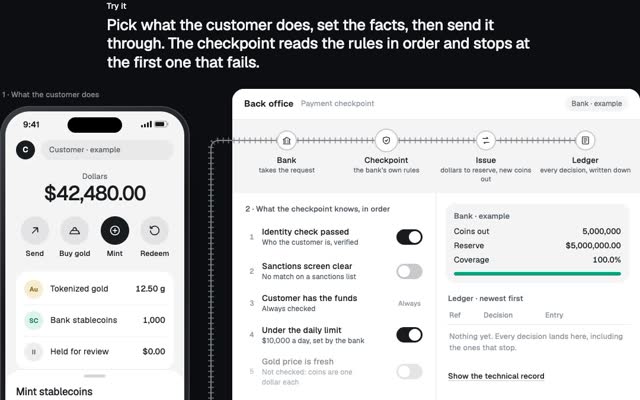
That last one is my work. The first build was a bank-in-a-box for a listed gold company: a white-label app where a bank’s customers hold dollars, stablecoins and tokenized gold in one balance. Every send or purchase goes through a checkpoint of 11 ordered rules with three outcomes: allowed, held, or unavailable when a fact it needs, such as the gold price, has gone stale. I also built a cross-border payments pitch for a network that settles between member banks in seconds: an interactive page where you switch one part off and watch the payment fail. Both are in forward deployed engineer: four AI and fintech builds.
Access to a stablecoin is easy to buy. The rules for who may send, mint or redeem, checked before the money moves and recorded, are the part you build.
What are the risks of a stablecoin?
- Depeg. In March 2023 more than $3 billion of USDC’s reserve cash was at Silicon Valley Bank when it failed. Circle’s own filing says USDC saw “a temporary price dislocation” on some markets until the funds were released. Put the reserve bank into failure in the report above to see the same shape.
- Issuer. You are trusting a company’s reserve, its banks and its report. Read the monthly report: what it holds, where, and who examined it.
- Sanctions. Issuers can freeze coins in a wallet. OFAC’s guidance says blocked virtual currency must be frozen and reported within 10 business days. Screen who pays you: a frozen coin pays no one.
Questions people ask
Is a stablecoin a cryptocurrency?
Yes, a token on a blockchain, but built not to move in price. A reserve and the issuer’s promise to buy coins back hold it at one dollar.
Are stablecoins safe?
As safe as the reserve and the issuer behind them. A coin backed by cash and short Treasury bills, reported monthly, is a different thing from an algorithmic one. Neither is insured.
Can a stablecoin lose its peg?
Yes. USDC slipped in March 2023 while part of its reserve was stuck at a failed bank, then recovered. TerraUSD broke in May 2022 and fell close to zero.
How do stablecoin issuers make money?
From interest on the reserve: Circle reported $668 million of it in the second quarter of 2026. Under the GENIUS Act, holders get no interest.
What is the difference between USDT and USDC?
Both are reserve-backed dollar stablecoins. Tether’s USDT is larger, about $184.6 billion in mid 2026, against $73.3 billion for Circle’s USDC. Each publishes its own reserve reports.
If you need this built, write to m@tawfik.tv, or see how I work as a fractional CPO.