Cross-border payments with stablecoins: how they work, what they cost, and when they beat SWIFT

A stablecoin payment turns your money into a dollar token at a licensed partner, moves that token across a blockchain in minutes, and turns it back into local money at a second partner, who pays the supplier on the local instant rail. It beats a bank wire on speed almost every time, and on cost only when the conversions at each end are cheap and the payout market is deep enough for your amount.
The bar it has to clear is not high. On 9 October 2025 the Financial Stability Board reported that a cross-border business payment cost 1.6% on average, and 1.4 points of that was the FX margin. Only 39.6% of business payment services credited the payee within one business day, and 2.2% within an hour (data as of March 2025).
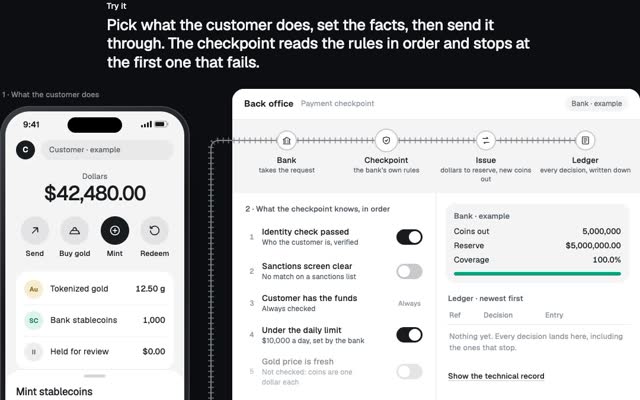
I’m Mo Tawfik Khalifa, chief product officer and forward deployed engineer at Instruxi. I built a cross-border payments pitch for a network that settles between member banks in seconds: an interactive page where you switch one part off and watch the payment fail. I also built the checkpoint that sits in front of every move in a bank’s stablecoin app.
What is a stablecoin?
A stablecoin is a token on a blockchain that is built to hold the value of a normal currency, usually one US dollar. The issuer keeps reserves behind every coin and swaps coins back for dollars. Under the US GENIUS Act, a regulated issuer has to back every coin at least one to one with cash, insured bank deposits, short-dated Treasury bills and a short list of similar assets, and publish those reserves every month (what the law allows banks to do). Because the coin moves on a blockchain, it can cross a border in minutes, at any hour.
How does a stablecoin payment work?
Six steps, and only one of them is on a blockchain.
- Onboard once. Your business passes KYB (know your business) with a licensed partner in your country: who owns it, what it does, where the money comes from. The supplier’s side needs the same at their end.
- Pay in. You send local money to the partner on your domestic rail, for example Faster Payments in the UK or SEPA Instant in Europe, which runs 24 hours a day, every day of the year.
- Check. The partner screens the payee against sanctions lists and attaches the sender and payee details that must travel with the transfer.
- Convert. The partner turns your money into a dollar stablecoin such as USDC. If you started in dollars, this is one for one, less a fee.
- Move. The coins cross the chain to the payout partner. On Ethereum a block is final after two epochs of 32 twelve-second slots, about 13 minutes. Network fees are small: $0.001 to $0.53 a transaction across chains, in a Harvard Business School study presented at the BIS annual conference on 26 June 2026.
- Pay out. The second partner sells the coins for local money and pays the supplier on their instant rail: RTP in the US, NPP in Australia, both open around the clock.
The same study calls this the stablecoin sandwich: the partners at each end do what correspondent banks do, holding fiat, running compliance and keeping custody. Stablecoins move the middle of the trip onto a chain. They do not remove the middlemen.
The big networks already use the middle part. On 16 December 2025 Visa launched USDC settlement with US banks over Solana, with stablecoin settlement at a $3.5 billion annualized run rate as of 30 November 2025, and named seven-day availability as a reason.
How do B2B cross-border payments move over SWIFT instead?
Your bank screens the payment, converts the currency and sends a SWIFT message. The payment hops through one or more correspondent banks, each screening it again, before the payee’s bank credits the account. Every bank works to its own hours and cut-offs.
For large payments, $100,000 and up, the hops are fast: Swift data in the same FSB report shows 88.5% cross the in-flight leg within an hour. The last bank is the slow part. Only 61.7% are credited within an hour of arriving there, so 54.6% land end to end within the hour and 93.2% within a business day. Smaller business payments are the ones that wait a day or more.
Where are the real costs in a stablecoin payment?
At the two ends, not on the chain.
- FX. It is 1.4 of the 1.6 points in the FSB average. Large global banks charged about 2% to 4.7% in FX on the personal wires in the Harvard study, plus a $25 to $45 wire fee. On exchanges, stablecoin rates for major currencies track the wholesale benchmark on average, but swing: about 0.87% day to day for sterling and 0.80% for Australian dollars, one standard deviation.
- Ramp fees. Published exchange trading fees run 0 to 1% per conversion, depending on platform and volume. If neither end is dollars, you convert twice.
- Off-ramp depth. A typical day’s exchange trading of stablecoins for Australian dollars was about $4 million in the study, $7.4 million for Mexican pesos and $17.4 million for sterling. A $1 million payout is a real share of that day.
- Compliance. It moves to your partners, and they price it in.
Try it. Pick a corridor, an amount and a deadline, then switch the off-ramp off or put the payee on a sanctions list.
Payments / New cross-border payment
Pay a supplier abroad
Compare the bank wire and a stablecoin route before you approve the payment.
Race to the payee's account
Clock Tue 10:00
Bank wire
Correspondent banking over SWIFT
Stablecoin
USDC through licensed partners
| Measure | Bank wire | Stablecoin |
|---|
Defaults from: FSB cross-border payments report, 9 Oct 2025 (business payment cost and speed, Swift wholesale speed); Du, Scharfstein and Huang, BIS annual conference, 26 Jun 2026 (wire fees, exchange fees, gas, stablecoin FX swings and daily volume); ethereum.org (12 s slots, 32 slot epochs, finality after two epochs); OFAC virtual currency guidance (blocking and 10 business day reports). The 16:00 cut-off is an example: check your bank's.
Pick a corridor, an amount and a deadline. Then switch a failure on and run it again.
What does a business need to send stablecoin payments?
- A licensed partner at each end. In the US the GENIUS Act, signed on 18 July 2025, sets who may issue a payment stablecoin, and from 18 July 2028 a provider may only offer US customers coins from permitted issuers, with narrow exceptions. I covered the bank side in can a bank issue its own stablecoin.
- KYB and a payee check. Expect the same ownership and source-of-funds questions a bank asks. Proving facts about a business without handing over its whole file is the subject of how to prove who someone is.
- Travel rule data. The sender’s and payee’s details must move with the transfer. In the EU this applies to crypto transfers regardless of their amount since 30 December 2024. In the US the rule covers transfers of $3,000 or more, and FinCEN’s 2019 guidance applies it to virtual currency.
- Sanctions screening on both routes. OFAC’s guidance for the virtual currency industry is plain: blocked virtual currency must be frozen and reported within 10 business days, as with any blocked property.
- Treasury plumbing. Who approves a release, and how each payment reconciles to its invoice: the same job as confirming an instant payment automatically.
What are the risks of stablecoin payments?
- Depeg. In March 2023 more than $3 billion of USDC’s reserve cash was at Silicon Valley Bank when it failed. Circle’s own filing says USDC saw “a temporary price dislocation” on some markets until the funds were released. The GENIUS Act will require one for one reserves and monthly reserve reports once it takes effect, by 18 January 2027 at the latest.
- Sanctions. A hit stops both routes at the first check. Issuers can also freeze coins in a wallet, so a payment can stop after it leaves you.
- Off-ramp liquidity. If the payout partner is offline or the market is thin, your money sits as USDC with no way into the supplier’s currency. Line up a second partner per corridor.
- Money that is not quite money. The BIS Annual Economic Report 2025 says stablecoins “perform poorly” on its three tests for money: singleness, elasticity and integrity.
When does a stablecoin beat SWIFT, and when does it not?
It usually wins when:
- The payment has to land on a weekend, a holiday or after your bank’s cut-off.
- One end is already dollars, so there is one conversion, not two.
- The amount is under $100,000, where wires are slowest.
- The supplier will accept USDC, so there is no off-ramp at all.
It usually loses, or ties, when:
- Your bank already quotes you close to the wholesale rate, so there is little FX margin left to save.
- The payout currency trades thinly in stablecoins and the amount is large.
- You have no second off-ramp and the payment cannot be late.
How I would decide: run both routes side by side on one corridor for a month of real invoices, and log time to credit, all-in cost against the benchmark rate, and every hold. Put a checkpoint in front of each payment that gives a plain-English reason when it stops one. The four builds behind that approach are in forward deployed engineer: four AI and fintech builds.
Questions people ask
How do stablecoin payments work for a business?
A licensed partner takes your local money, converts it to a dollar stablecoin and sends it on a blockchain. A partner in the supplier’s country converts it back and pays out on the local rail. Both partners check identity, sanctions and travel rule data.
Are stablecoin payments faster than SWIFT?
Usually. The chain step takes minutes and the instant rails at each end run all week. Only 39.6% of business payment services credit within one business day, per the FSB.
Are stablecoin payments cheaper than a bank wire?
Sometimes. The chain fee is cents, but ramp fees run 0 to 1% per conversion. Against the 1.6% business average, it wins when one end is dollars and the payout market is deep.
What is the travel rule for stablecoin payments?
The sender’s and payee’s details must travel with the transfer, as they do with a bank wire. The EU applies it to every crypto transfer a provider handles, whatever the amount. The US applies it from $3,000.
What happens if a stablecoin loses its peg mid-payment?
The coins can trade below a dollar for a while, as USDC did in March 2023. A payment that takes minutes has little exposure. Coins waiting at a stuck off-ramp have more.
What are the main B2B cross-border payment solutions?
For most businesses, two routes: a bank wire over SWIFT through correspondent banks, or a stablecoin route, where a licensed partner at each end converts the money and pays out on the local instant rail. Some bank networks also settle between member banks directly, in seconds; I built a pitch for one. Choose per corridor: stablecoins win on weekends, after cut-offs and when one end is already dollars, while wires hold up when your bank’s FX rate is close to wholesale or the payout currency trades thinly in stablecoins. Run both side by side on one corridor for a month of real invoices before you switch.
If you need this built, write to m@tawfik.tv, or see how I work as a fractional CPO.