Work with me · Medical device 3D animation
Medical device 3D animation and interactive training
I make mechanism of action animations, 3D device films and interactive instructions for use that a clinician, a hospital buyer or a trainee can operate in a browser. One model, built from your CAD, gives you the film, the interactive demo, AR, VR and the stills for print.
Try it before you read on. The pump on this page is an invented device, modelled and rendered for this page: turn it, take it apart, load it, prime it and run it, and break the rules to see how it refuses.
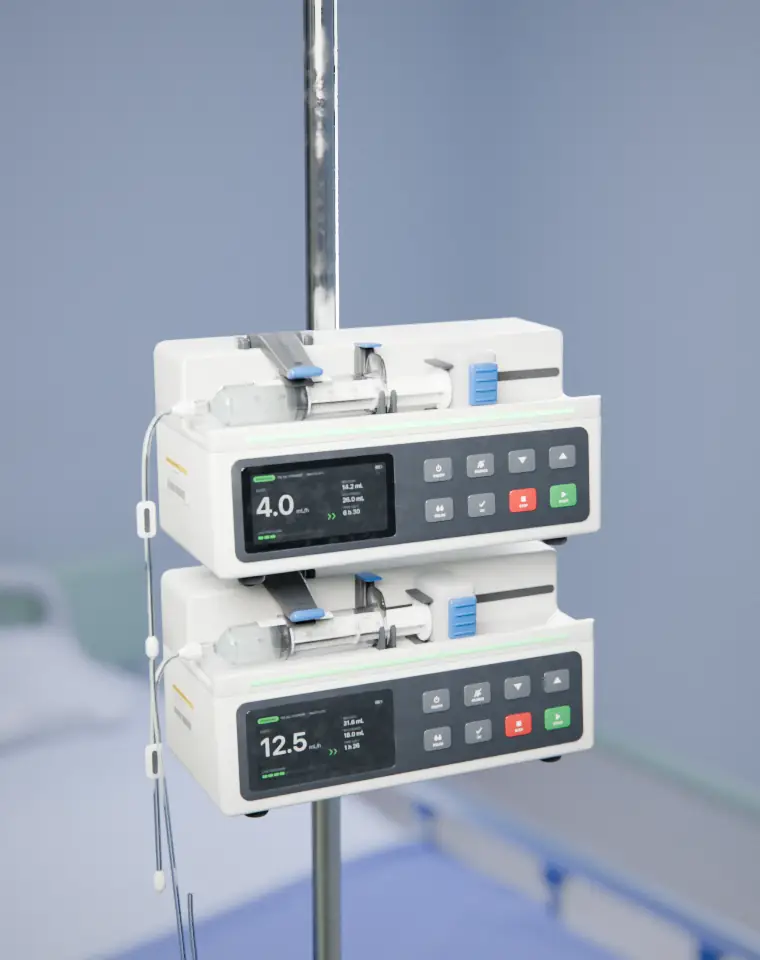
Rendered in Blender Cycles. Drag to turn it. An invented device: illustrative, not for clinical use.
- Covers
- Mechanism of action animation, device films, interactive IFU and training, AR and VR, sales and trade show demos, healthcare apps
- Built from
- Your CAD (STEP or IGES), your IFU, your brand guide
- Reviewed by
- Your medical, regulatory and legal team, before anything is rendered
- Demos here
- Illustrative, not for clinical use
Before you brief anyone
Worried it gets stuck in medical, legal and regulatory review?
35% of medtech teams need 3 to 5 review rounds, and 35% take 4 to 6 weeks or more to approve content.
From the Veeva 2024 MedTech Commercial Benchmark, a survey of 130+ commercial leaders by a company that sells review software.
Your reviewers see the script and the storyboard frames, with every claim next to its reference, before anything is rendered. A change at that stage is an edit. A change after rendering means rendering again, so I do not render until they have signed.
“…every claim will come back for review over and over and over again.”
Kate Nichol, VP of Clinical and Medical Affairs at LivaNova, on a Veeva MedTech panel about review.
You get one claims sheet: each claim, its reference and when it was approved. The film, the interactive demo and the stills all draw from that sheet, so a claim your team approved once stays approved in every format.
“Review can become frustrating, or impossible, when existing technology cannot work with the media or file formats that need to be approved.”
The same Veeva MedTech panel write-up.
I send review copies in the formats review systems take: the storyboard as a numbered PDF, stills, and an MP4 with timecode. For an interactive demo, a PDF of every screen and every message it can show, so nothing on screen goes unreviewed.
Will we be stuck with whoever made the model?
The model is the expensive part, and the next film, the AR file and the brochure stills all start from it.
You own the 3D model, the source files and the repo from day one, and you get a written handover, so the next piece does not depend on me.
What you get
- The model, source files and repo are yours from day one.
- A fixed price in writing after the first call, before any work starts.
- Work in progress on a live link you can click every week.
- You talk to me, the person who builds it, not a salesperson.
- A written handover at the end.
Flagship · Interactive IFU
Instructions you can touch

Each step plays a rendered clip. Drag to turn the pump in real time, or tap its parts.
Ready to tryStart with step 1, or press Start first and see what the pump says.
Why build training like this? A paper IFU tells you the order. A model that refuses the wrong order, with the reason on its own display, makes the trainee learn why the order matters: no syringe moves while clamped, no start with air in the line, no start on a guessed rate.
How it is made. Modelled in Blender for this page: moulded shells with draft and a parting line, a membrane keypad, a display under glass, a clear syringe with liquid in it. Each step plays a clip rendered in Cycles; drag the pump, or pick Exploded or X-ray, and the same model takes over in real time in three.js. A real project starts from your CAD and your IFU, and the same model gives you the film, the AR file and the print illustrations.
Rendered film · Exploded view
Fourteen parts, one model
Scroll and the camera takes the pump apart: every part lands in place and names itself. The same model drives the clips above and the real-time version.
Medical animation · Mechanism of action
A mechanism of action animation you scroll through
A mechanism of action animation shows what a drug or device does at the scale nobody can film: what it binds, what changes, and what happens next. This one is rendered in Blender, and your scroll is the playhead. It is generic on purpose, the shape of the idea rather than any real medicine.
Illustrative and generic: not a real drug, receptor or pathway. Not for clinical use.
Deliverables
What I build for medical device teams
What a medical device marketing agency would commission from a 3D studio and a web team, from one builder. The model is the expensive part, so it is built once and reused for every format below.
| Deliverable | What it does | Built from |
|---|---|---|
| Mechanism of action animation | Shows how the therapy or device works in the body, for sales teams, congresses and patient education. | Your approved science and claims |
| Medical device animation | A rendered film of the device: how it works, what is inside, how it comes apart. Loops on a booth, cuts into clips. | CAD, a script |
| Interactive IFU and medical device training | The device on a web page that trainees operate step by step, with the real alarms and the reasons, like the pump above. | CAD, your IFU, your alarm list |
| AR and VR | The device at real size on a table or a ward through a phone camera from a link, or hands-on practice in a headset. | CAD, finishes, target headset |
| Sales and trade show demos | A link a rep sends, a touchscreen on the booth, stills for the brochure and the deck. | CAD, brand guide |
| Healthcare and telemedicine app development | Apps and portals where identity, consent and sharing only what is needed come first. | Your workflow and your data rules |
Process
How a project runs
- Week oneBrief
The device, the audience, where they will see it, and the one thing they must understand.
- ModelBuild the 3D
From your CAD or drawings. Your engineers check the model before anything is lit.
- ReviewStoryboard
Frames and script, approved by your medical and regulatory reviewers before anything is rendered.
- BuildMake it
Film, interactive, AR or VR, tested on the phones, laptops and headsets your audience uses.
- DeliverHand over
Every format you need, plus the model, so the next piece starts from it.
Proof
What I have built that this draws on
A mobile app for iOS, Android and the web. Licences verified against the issuing authority, an alert before one expires, and sharing that sends only the fields a clinician ticks, to one recipient, for a set time, revocable at any time. Through QA and submitted to App Store beta.
Identity · PrivacyHow to prove who someone is without seeing who they arePrivate identity built three times, including a licence nurses share without their whole file.
Identity · Live demoVerifiable credentialsA working wallet in the browser: a nursing board signs a licence, a hospital checks it, and you try to cheat.
3D film · Interactive · AR3D product animation for industrial equipmentA Blender film of a 1,148-tube heat exchanger, seven interactive equipment families, and an AR model in a 1.2 MB glTF file that opens from a link.
Service · ManufacturersIndustrial website design and 3D product animationThe same pipeline of films, interactive 3D and AR, offered to equipment makers.
Free tool
Which 3D deliverable do you need?
Pick your goal, your audience and where they will see it. You get the format that fits, why, and what to gather before the first call.
Before the call
What to bring
- The device and the audience you want to start with.
- CAD in STEP or IGES, drawings, or a sample device. Any one is enough to start.
- Your current IFU, and any claims or scripts your reviewers have approved.
- Your brand guide, and where the piece will be shown.
- 30-minute call. Your device, your audience, your deadline.
- A written plan in 48 hours. The formats, what I need from you, how long it takes.
- Start, or not. Use the plan with your team or with me. I reply to every email within one working day.
Limits
What an animation does not replace
An animation or an interactive guide helps people understand a device. It does not replace:
- The label and instructions for use the device must carry: in the EU, Regulation (EU) 2017/745, Annex I, Chapter III; in the US, 21 CFR Part 801.
- Paper instructions where they are required. Electronic instructions instead of paper are allowed only for certain devices for professional users, under Commission Implementing Regulation (EU) 2021/2226, and paper must still be supplied on request.
- Human factors validation. See the FDA guidance Applying Human Factors and Usability Engineering to Medical Devices.
Every demo on this page is illustrative and not for clinical use. On a project, your regulatory team decides what the animation may say.
FAQ
Questions people ask
What is a mechanism of action animation?
A short animation that shows how a drug or a device works in the body: what it binds or changes, and what happens next. Your medical, scientific and regulatory reviewers check the science and the claims; the animation makes them visible.
What is medical device animation used for?
Sales demos, trade show loops, training clinicians and staff, explaining the device to patients, investor decks, and illustrations for printed instructions. Build the 3D model once and the same files serve all of them.
Do you need CAD files?
CAD in STEP or IGES gives the most accurate result. Drawings, photos and a sample device work too: I model from them and your engineers check the result.
What is an interactive IFU, and can it replace the paper one?
An interactive IFU lets a user step through the instructions for use on a 3D model of the device. It supports training and understanding; it does not replace the labelling and instructions your regulators require. In the EU, electronic instructions instead of paper are allowed only for certain devices for professional users, under Commission Implementing Regulation (EU) 2021/2226. In the US, labelling is governed by 21 CFR Part 801.
Can 3D animation be used for medical device training?
Yes. Trainees can practise steps, alarms and fixes on a model before they touch the device, in a browser or a VR headset. It adds to your training programme. It is not human factors validation testing, which the FDA describes in its guidance on applying human factors and usability engineering to medical devices.
Are you a medical device marketing agency?
No. I am one builder who makes the 3D, the interactive pieces and the web pages a medical device marketing agency would commission, and I work alongside your agency, your marketing team and your regulatory reviewers.
Do you build healthcare and telemedicine apps?
I led a credential passport app for clinicians on iOS, Android and the web: licences verified against the issuing authority, shared field by field with one recipient for a set time, and revocable at any time. Telemedicine apps need the same parts: identity checks, consent, sharing only what is needed, and a record of who saw what.
Who checks the medical accuracy and the claims?
Your medical, regulatory and legal reviewers. I build from material they approve, show the storyboard before anything is rendered, and change nothing in the science without their sign-off.
If you have a device to explain, write to m@tawfik.tv with what it does, who needs to understand it, and what files you can send.